
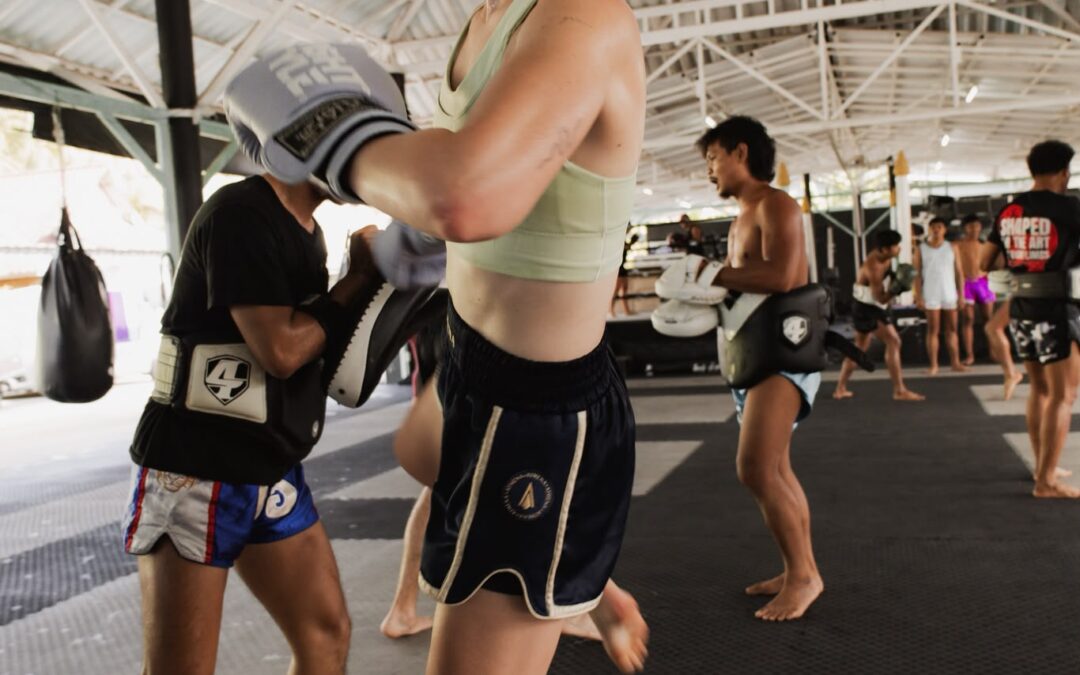
On unconscious inhibitions, early learning experiences, and the possibility of discovering new ways of acting through combat sports.
There’s something I keep noticing in training: I go into a movement, give it everything I have, feel powerful, intense, sometimes even wild. And then, when I watch a video of myself later, I’m surprised. Because from the outside, it looks very different from how it felt.
I see control. Tension. A certain amount of hesitation. Movements that don’t quite follow through. As if, in the very moment when I’m giving it my all, I’m still holding myself back a little. I’ve known this discrepancy for a long time. Especially in activities that require a more expressive, physical kind of movement: dancing, certain types of movement, and now, particularly, combat sports.
I thought I was fully in it. And then I see that there’s still a brake somewhere. What’s unsettling is that I don’t even consciously notice it. I have to see myself from the outside to realise just how much restraint is still present in my body.
Sometimes I think I just need to scream really loudly, shake myself out, jump up and down, move without immediately trying to control the movement again. As if there’s something I need to shake off that I can barely put my finger on.
At the same time, I’ve been exploring these kinds of topics for years. I can reflect on my patterns, make sense of them and understand them. And yet, they don’t simply disappear. To me, this is a reminder that understanding something about ourselves doesn’t necessarily mean we can immediately change how we experience it.
So why do we still hold ourselves back, even when we’ve long understood that we don’t have to? That we’re allowed to be loud, to be powerful, to disagree, to feel anger, and that we don’t have to constantly monitor how we come across to other people?
What role our early experiences can play
Perhaps we learned very early on that it was better, and felt safer, not to disagree. That other people became irritated when we were too demanding. That we received approval when we were easy to deal with, put our own needs aside or kept our emotions under control. Perhaps we had to pay attention to how other people were feeling from an early age, to the mood in the room, and to how much space we could take up without triggering a negative reaction.
Many of these experiences happen before we’re even able to consciously make sense of them. We develop expectations and ways of behaving without ever putting them into words. We don’t just learn what to think about ourselves, but also how to behave in certain situations.
Not all of these experiences have to be particularly dramatic. There doesn’t necessarily need to be one defining, life-changing event. Repeated, seemingly everyday responses from others can also shape which behaviours we learn to favour and which we express less often. We may not only learn: I should hold back. We also learn to monitor ourselves, control our impulses and anticipate how other people might react. This kind of control can be useful. It helps us navigate social situations, consider other people’s needs and avoid conflict. It becomes more difficult when we learn to rely on it so early that it eventually feels completely natural, and we no longer notice when we’re doing it.
We might then hold ourselves back before we’ve even consciously decided whether we want to. We might soften a movement, find ourselves physically inhibited when we want to speak up, or take up less physical space than we actually would like to. Later, we might look back on a situation and wonder why we felt so inhibited in the first place, why we couldn’t access all the ways we could have responded, or why our bodies seemed to hold us back.
And it can be incredibly frustrating to understand a pattern and still find yourself repeating it. This gap between rational understanding and what we’re actually able to do with our impulses and physical movements makes me wonder whether questioning everything rationally is enough.
As adults, we can understand that we’re no longer responsible for every reaction other people have. We can know that we’re allowed to disagree, that our needs matter and that it’s okay to take up space. But this knowledge doesn’t automatically change all the expectations and responses we’ve developed over the years.
And that raises another question: What needs to happen for me not only to know, rationally, that I’m allowed to move more freely, but for my body to actually put that knowledge into practice in the moment?
Why combat sports can help
This brings me to something I’ve experienced through combat sports: I have to act. I can’t spend all my time focusing on how I feel or trying to figure out why I might be inhibited. I have to execute a movement. Respond to a stimulus. Make a decision. Use force. Engage with a situation I can’t fully control.
That doesn’t mean my habitual response automatically disappears. I might still feel the tension. I might hesitate, hold back a movement or only realise afterwards how much I was controlling myself.
But I get the chance to try again.
This is psychologically interesting because change doesn’t always require fear or inhibition to disappear first. Sometimes our behaviour changes while we’re still experiencing the uncomfortable feelings. In a way, I’m turning the process around. Instead of starting with rational understanding and trying to transfer that knowledge to my body, I repeatedly make new experiences on a physical level. Experiences that take me out of purely rational thinking and analysing, and allow a different kind of understanding to emerge.
In training, for example, I can experience what it feels like to throw a punch with more commitment, even when that feels unfamiliar. That I can use force without completely losing control. That I can make a mistake, receive feedback and try again. Or that I can be physically present without constantly watching myself from the perspective of other people.
When these experiences happen repeatedly in a sufficiently safe and well-guided environment, they can create opportunities for new learning. The original expectation — that taking up space feels dangerous, embarrassing or wrong — doesn’t have to disappear immediately. But it can be accompanied by different experiences. My body can gradually learn: I’m allowed to move with force. I can handle the feeling of being seen. I can tolerate the uncertainty that comes with doing something differently from what I’m used to.
This doesn’t guarantee that these experiences will automatically carry over into other areas of life. Acting decisively in training doesn’t necessarily mean we’ll suddenly start setting boundaries in relationships or feel more confident at work. But the experience can give us something to draw on in other situations.
Combat sports offer a particular setting for this kind of learning: they combine physical intensity with clear tasks, immediate feedback and the opportunity to practise an action repeatedly. We can observe what happens when we don’t immediately retreat, and experience that we have some influence over how we act.
And gradually, our range of possible responses can expand. We don’t have to be completely free of inhibition before we can act differently. And we don’t have to overcome every inhibition to feel freer. But over time, we may develop more options: to notice the impulse to hold back and still decide for ourselves whether we want to stay cautious or move towards that impulse and choose to take up more space. Perhaps that choice only truly becomes available when we haven’t just understood it, but have experienced it again and again.
photo by https://www.celinecreatez.com