
When anger has no space
Many women have learned that anger is not really an acceptable emotion. That they should be kind, accommodating, agreeable and polite – and that loudness, intensity and taking up space are rather inappropriate or unwanted.
Often, this is never said explicitly. It happens subtly. Angry girls are regulated, but not necessarily heard in their anger or supported in understanding it. Boys are more likely to be asked: “Are you angry?” Girls, on the other hand: “Are you sad?”
There is often less space for anger.
Over time, these expectations become internalized, not only consciously, but on a deeper, often unconscious level. As a result, many women may feel no longer fully connected to themselves. They may not fully understand their emotions or trust them. They may question themselves more than the situation around them.
Perhaps beneath this lies a fear of aggression. The concern that (female) anger is something that could get out of control and is therefore better not given space at all.
When anger turns inward
But anger does not disappear. If it has no space outwardly, it often turns inward instead. And there, it tends to show up differently: As tension, as withdrawal, as a state in which one continues to function, but no longer really feels oneself.
When not every emotion is allowed to exist, when not every reaction is taken seriously, at some point it becomes necessary to no longer fully allow a part of oneself. Not fully feeling oneself can then even become a form of protection.
And honestly: That makes sense.
Why this makes sense
In trauma research, it is often discussed that not only fear, but also suppressed anger can remain stored in the nervous system. If this energy does not find expression, it often shows up as tension, withdrawal or a form of inner freezing.
At the same time, anger – like all of our emotions – has an important function: It helps us feel our boundaries and stand up for them. It gives us the energy to defend ourselves and respond to experienced injustice.
From this perspective, it makes sense that one can feel paralyzed and frozen when exactly this kind of energy is not allowed to exist. What once emerged as protection can later feel like a distance from one’s own experience – as if one no longer fully understands oneself or cannot quite make sense of one’s own reactions.
What happens when anger is given space
This raises the question what happens when this energy is given space again – and what actually brings us back into contact with ourselves.
Research increasingly emphasizes that movement plays an important role in mental health – including in depression, anxiety and stress. At the same time, there are initial studies suggesting that more intense, physically direct forms of movement can reduce symptoms of stress and trauma.
It seems that it is not only the movement itself that matters, but also what happens within it: Reaction, physical contact, resistance, presence. In other words, exactly those elements that bring us out of a state of withdrawal and back into action. When anger is no longer directed inward, but begins to move. Especially in forms of movement that are less about control and more about reaction.
Perhaps because these forms of movement not only activate the body, but also create direct experiences of presence, boundaries and response on a level that goes beyond words.
Anger in movement
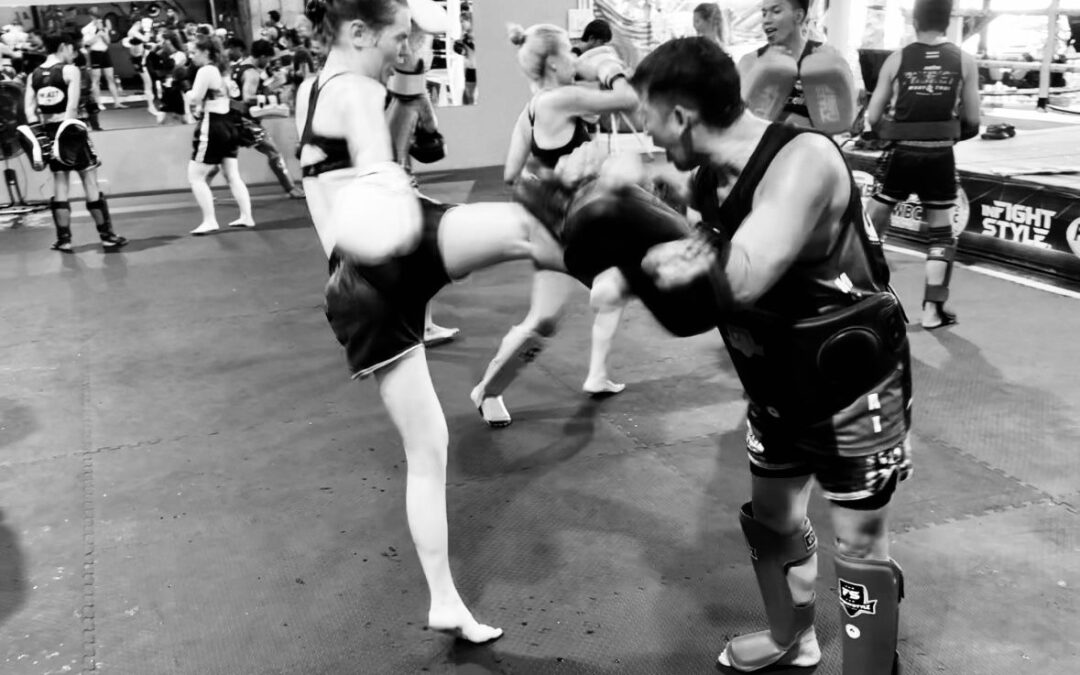
Examples include forms of exercise such as strength training, CrossFit or martial arts. They represent ways of moving in which one does not have to become quieter, but rather clearer, more direct, more present. Martial arts is only one of many possibilities, but one in which this kind of presence becomes particularly tangible.
For many, it feels like a wake-up call – as if the body, after a state of inner withdrawal, suddenly comes alive again. Because a form of energy
that often has no place in everyday life is suddenly given space.
Through the physical experience of one’s own strength, a sense of self-efficacy can return, and with it, often, the connection to one’s own body.
For many, martial arts feels almost like a direct translation of the function of anger into action: Defending one’s own (physical) boundaries. In a combat situation, one is, in a way, forced to be fully present. There is no space to be only half there or to withdraw. One has to respond, stand up for oneself, stay on one’s own side – to take one’s perceptions seriously, trust one’s impulses and feel one’s boundaries.
Back into connection
And perhaps this is where something essential lies: No longer questioning oneself, but beginning to rely on oneself. And allowing all inner parts to have space and legitimacy to be experienced and expressed.
In this sense, martial arts can act as a counterbalance to suppressed anger. Not because it is about aggression, but because the very energy that often had no place can be integrated here. Not as something that needs to be controlled or suppressed, but as a healthy and important part of oneself: A form of strength that can help one stay connected to oneself and stand up for oneself.
At the same time, it is not about martial arts or strength training being “the solution.” Rather, it is about reconnecting with one’s own potential for strength, energy and movement. To experience that within one’s body there is a form of energy that can take up space, meet resistance and, if necessary, even strike.
And to experience this potential not as something dangerous,but as something that is allowed to exist. Perhaps this opens up a different perspective:
That not only anger is allowed to be there, but also the strength within it – and that, through this, a renewed sense of connection to oneself can emerge.